Tuesday, September 16, 2014

(9/16/14) More about Heat Engines

In this lab, we went into a more insightful idea of heat engines, deriving and working with different types of engines with different processes.

In Class Activity: 
A picture of our experiment
In the beginning portions of the lab, we take a simple engine, one side with cold water, and one side with hot water, and observe what the engine does. We predicted that this is a very simple method of creating an engine, as energy will flow from the hot reservoir (hot water) into the cold reservoir. 

A video of the engine spinning counterclockwise
 
As our predictions stated, the engine span in a counterclockwise direction. (It is to note that the water was not hot enough for it to spin normally, so we had to heat it up using a lighter)

We were then asked the question, what would occur if we were to flip the hot and cold reservoirs. Our group predicted that the engine would flip flop as well, spinning clockwise


A video of the engine spinning clockwise
Once again, our prediction were correct, as the engine spins clockwise, as the video shows.

We then went additionally as to what would happen if we connected the engine to a wire and let electricity flow. We stated that since electricity works in a way similar to heat engines (flowing from positive to negative as opposed to hot to cold) that it will still spin


A video of the engine connected via electricity
Once again, as our prediction stated,  the electricity flow allowed the engine to work in a different scenario.


The Incredible Mass Lifting Machine
Our next setup of our lab
The Incredible Mass Lifter Heat engine, our next experiment, is a system in which we test a mass of around 1kg, and place the environment at certain pressure, volume, and temperature, to observe changes on the system.


Our calculations and predictions on the heat engine (bottom)
We were asked about what kind of process occurs to the system during certain points, in which we explained were either isobaric or isothermal depending on what value was being changed.
Our observation from each points of the mass lifting machine were as follows:

At point a→b, we observed the mass going down, which is what we predicted would occur (isobaric)
At point b→c we observed the volume increase (thereby pressure decreased) as we placed the "can" into the hot reservoir, which is what we predicted were to occur (isothermal)
At point c→d we observed the volume increase more as the weight was removed, since there was now nothing holding the tube down, which is again what we predicted. 
At point d→a we observed that the volume, once placed into the cold reservoir, went back to its initial position, meaning an nothing, if not an insignificant amount of air was lost during the experimentWe can also state that the pressure should be the same since the cycle has returned back to normal, and the gas is in the same state as it was initially.

Determining Pressures and Volumes:
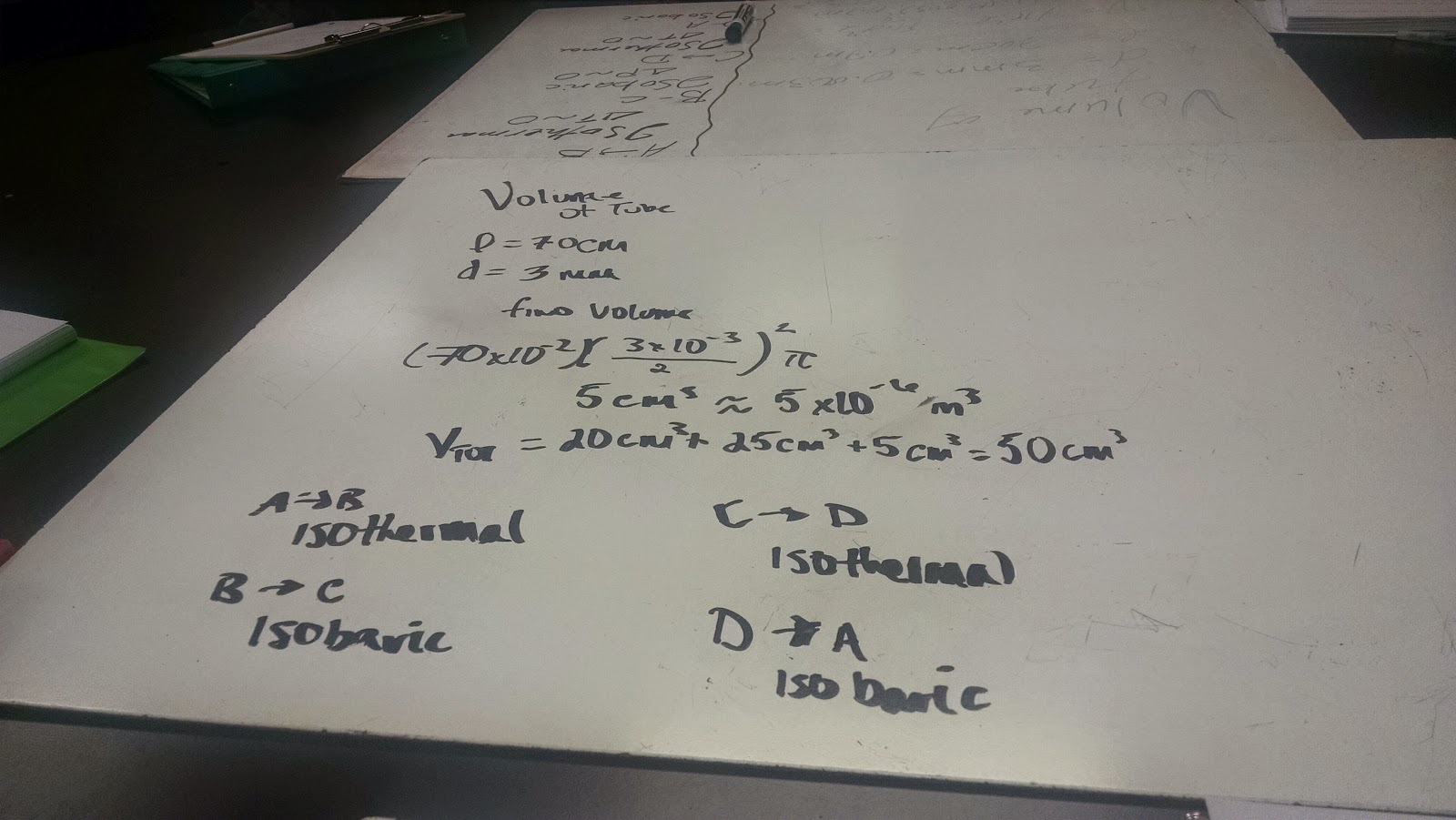
Our calculations on the cylinder (top)

We were asked to find the volume of a cylinder with diameter d and length L

We found that to be V = π(d/2)^2 l


Our calculated answers

We then took our data that we obtained from before, and plugged it into a chart to look at the scenario with numbers. 

As predicted, the pressure of the last step is around the same as the pressure in the first step, since everything was placed back into their initial positions. Steps 1 to 2 and steps 3 to 4 are seen to be adiabetic, since the system is going to fast for it to stay at a constant temperature, while steps 2 to 3 and 4 to 1 are isobaric, as only temperature and pressure were seen to change (caused due to the weight being placed on the system)


Adiabetic Expansion Activity:
In this portion of the lab, by using the ideal gas law, we needed to prove the relationship between moles and temperature to the change of volume, volume, change of temperature, temperature, and R (Cp - Cv)
Our entire calculations of the procedure

Additionally, we needed to use the proof we had in order to find the relationship between temperature and volume during an adiabetic process. Since we already had the proof proven in the previous photo, we skipped a few steps in order to speed up the process. 

Calculations of said relationship between temperature and volume

Work in an Adiabatic Expansion:We then discussed about finding work in an adiabatic expansion, using the equation that W=(integral of) Pdv


Our work, showing how to calculate for work in an adiabetic expansion

We then went straight into a Carnot Engine, involving a mole of an ideal monatomic gas for the final portion of the class period

Our calculation for the Carnot Cycle System


Take Home Quiz - Diesel Engine

The following work is based on the Diesel engine take home quiz that we were given on Thursday 9/11/14

The completed worksheet
In order to gain a better understanding of engines, we were given a worksheet of Diesel Engine, and were asked to fill it out.
The following shows the answers filled out


The next following pages shows the work required to find pressure, volume, temperature, heat, work, and internal energy at specific times

Page 1 of the work

Page 2

Page 3

Thursday, September 11, 2014

(9/10/14) Heat Engine

In this class, we learned about the basics of how a heat engine (and the wonders of the 20th century)

Candle in Cylinder Activity:
Our prediction of what would occur to the candle
During the beginning portion of lecture, we were asked to predict what would occur if we were to place a lit candle inside a graduated cylinder.
Our prediction states that we believed that the candle would go down, since it takes longer for the oxygen to reach to the graduated cylinder


The video of what actually occurred
It was through our surprised that the candle quickly let out. This occurred because the fire was cut off from its plentiful environment of oxygen, and burned out what little it could have.
Additionally, this actually took two attempts to do, as the first time the candle ran out faster than we could place it in to the bottom of the cylinder.


Prediction part 2
After understanding what made the candle light out so quickly, we then were asked a similar question. "What would occur to the fire of the candle, if you were to place an additional cylinder to be placed upon the candle"
My original thought was that since you were decreasing the amount of oxygen inside the cylinder even further, that the candle will then diminish, at around the same speed.


Video of Experiment part 2

Once again, we were proven to be incorrect. Now that the candle has a way for oxygen to reach into the cylinder, it was able to last longer than it was during the first portion of the experiment.
We can see this kind of effect happening in our daily lives via a chimney, as a chimney is basically a funnel for oxygen to enter into the house, in which the fire can use allow itself to continue burning


Candle in a closed container activity:


In this activity, we took a candle inside a closed container, and were asked what was to happen to the candle while the closed container were to fall a few feet.
Our prediction states that the candle's light should get dimmer, due to the amount of gravity that it is being pushed on about.


A video of a video of the experiment

Watching the video, we came to the conclusion that our prediction was indeed correct, but the reasoning was completely off. The fact is that while it was falling, convection current was no longer occurring, which is what gives the candle is straight-like figure. What took over instead was diffusion, which forces the candle to become dimmer, as the energy was dispersed evenly

Additionally, if a candle was to be taken to space and lit, we also learned that a similar effect were to occur, where diffusion becomes the primary effect, and the candle would be a arc-shaped, rather than the common fire shape that we know it as.


State Variable and Ideal Gas Law Activity:
We then were sent to do the next activity on the computer, answering the six questions that were given to us
Answer to question 1

The first question was about isobaric (constant pressure) process, in which we were to find a relationship between volume and temperature.

We answered stating that since pressure is constant, then, by the ideal gas law, we can then state that volume and temperature (which is supposed to be notated by T), is directly proportional to each other.


Answer to question 2

The second question related to isochoric (constant volume) process, once again finding a relationship between pressure and temperature

Using the ideal gas law, and know that volume is constant, we found out that pressure and temperature is again directly proportional to each other.


Answer to question 3

The third question talks about isothermal (constant temperature) process, and asks us to find a relationship between pressure and volume

Using the Ideal Gas Law as a base once again, we find that pressure and volume are actually inversely proportional to each other, when pressure increases, volume decreases, and vice versa.


Answer to question 4

Question 4 gives us a scenario in which we have 1 moles of a gas at 500K and pressure of 42kPa. They want to know the pressure in the gas when the temperature is lowered to 300\1.8K
There are two ways to approaching this question. One was by using the ideal gas law, and given the final temperature, amount of moles, the constant R and the pressure, we can easily find the volume.
The second way was by understanding that since moles, the constant R, and pressure are all constant, we can easily find the volume by reducing the ideal gas law to V1/T1 = V2/T2, and solve for V2, with V1, T1 and T2 all given to us.
The answer we came up was around 25 m^3, which is the same answer as the advisor obtains as well

Answers to question 5 and question 6
Both question 5 and question 6 are a variation of what question 4 was asking of us, instead of asking for volume, asked for pressure.
Like question 4, we can easily solve this question by understand which variables of the ideal gas law is not constant, in this case, pressure and temperature, and solving for them, given the initial pressure, initial temperature and final temperature.
Question 5 we obtain around 126kPa
Question 6 is a two-part in which we obtained 124kPa and 248kPa respectively

Working Rubber Band Activity:
In this activity we were asked what would happen to rubber band as it is heated up.
We predicted as a group, that what we knew about thermal expansion of a substance, that if you were to heat up a rubber band, in turn the rubber band will expand.
However, within the lecture, we learned that not to be the case that a rubber band will indeed contract upon itself due to the chemical structure of rubber.

We then used this idea of contracting rubber to create a makeshift mass-lifting engine thought idea.
A version of a workable cycle

We were asked to create a cycle the can repeatedly lift cans to the packing conveyor using rubber.
We stated that one cycle of lifting a can requires the following steps:
1) Put can on rubber
2) Heat up rubber
3) Unload
4) Cool down rubber band
We can point out that the heat is entered into the rubber during the second step of the cycle, that the heat energy is going along positively, and then removed at the last step, and the rubber band is once again elongating to its original position.

Additionally, if we were to take this idea, and place it into a factory during a hot day, we would observe that our makeshift engine would not work, as there would be no way to remove the heat, which is a necessary step for this model engine to work.

We also have to note that not all 100% of the heat energy used in this experiment goes through the process of our makeshift engine. We should note that a portion of the energy is going to heating up, and cooling down the rubber itself, which we cannot gain back in terms of mechanical energy.

Defining Efficiency Activity:
Our next portion of the lab goes to understanding engine efficiency, notated by η
we can state that η is equal to W/QH , where W is the work and QH is our hot reservoir. We can then state that W = QH-QC  where Qc is the cold reservoir, and with a simple amount of math, obtain the term η = 1-Qc/QH 

Its to note that if we were to obtain an engine with no waste heat, Qc would equal to zero, QH would equal to infinity, and η would equal to 1

Analyzing the Cycles:
Our processes of finding the work and heat (incomplete)
In our last experiment, we wree to mathmatically find the work, heat, and internal energy of a cycle in each of their respective parts.
By creating a crude graph, we found that this cycle creates a square-like graph (as shown by the photo) which each point being a different step of the cycle.
Additionally, we found work to be done on the gas at step A and step C, while by the gas at steps B and step D. while heat energy transferred to the gas from a reservoir at steps AB and BC, and vice versa at steps CD and DA

Finding work and heat (completed) 
Afterwards, we were to evaluate Eint at each ponits using the equation Eint = (3/2)PV
We came with the following answers for this portion of the lab
1) 12240 J
2) 15300 J
3) 11,350 J
4) 9,480 J
We then were able to similarily find ΔEint, work and heat energy respectively (all numbers are rounded up to make overall math simplier)

ΔE int (A) (15300-12240) = 3100 J
ΔE int (B) (11350-15300) = -4000 J
ΔE int (C)  (9480-11350) = -1900 J
ΔE int (D (12240-9480) = 2800 J

Wa = 2000 J
Wb = 0 J
Wc = -1600 J
Wd = 0J

Qa = 5100 J
Qb = -4000 J
Qc = -3500 J
Qd = 2800 J

We know that since the work is being done on its surroundings, the gas is therefore expanding, and work becomes positive, and vice versa for work negative, as it is contracting and work is being done on the gas. 

We were then asked to find the net work, the sum of all the work (Wnet = Wa + Wb + Wc + Wd)
Wnet = 2000 + 0 -1600 + 0 = 400 J
Lastly, we were asked to use the rectangular graph, and use it to find the net work (finding the area enclosed in the rectangle) and see whether or not they are around the same. 
Since area of a rectangle is length x width
A = (0.10-0.08) x (1.02x10^5- 0.079x10^5) = 400 J
Its to note that due to the rounding, the numbers tend to be exactly the same, in which might not have been the case, if we took their precise numbers.

Tuesday, September 9, 2014

(9/9/14) Work and the First Law of Thermodynamics

In this lab, we are covering over work, heat, and the internal energy of the system, and how the idea of the First Law of Thermodynamics was formed off of these three forms of energy

Relating Work and Pressure Mathematically:

A revisit set-up from the last lab
We first started this lab by bringing up the heated syringe lab activity we used to find the relationship between volume vs temperature. This time, however, we asked what occurs to the gas if we were to keep the plunger fixed. How would the gas react to keep itself at equilibrium


A demonstration of how to keep the plunger at bay.

We find out that in order for the plunger to stay at a fixed distance, that work has to be applied onto the plunger by an external factor (in this case, Prof Mason's index finger) in order for the plunger to stay fixed. Of course, when the index finger is removed, so is the external work done to the plunger, and it is free to move up, as it should. 


Giving this term of work a mathematical definition
We moved straight along to give a definitive definition of work, which we find out to be the integral of Fdr, where F is the force, and dr is the differential of the distance moved.
To take the definition a bit further, we took the idea of Force, which is Pressure x Area, and substituted it for force. Realizing that Adr (which we made dx to give the term familiarity) is just dV (area being meters squared, and dx being meters), we then derive the term that work is equal to the integral of pressure by the change in volume


Finding Work
 A two part problem, testing our knowledge of the First Law of Themodynamics
The first part gives us mass, ΔT, and pressure, and we are to find the work applied, in which case we first needed the final pressure, which was unknown as well.
The second part of the problem asked us to first find the Q (heat), and once we found Q, we then find the ΔU (internal energy) of the system.
Finding Q was just the process of Q=mcΔT
Finding ΔU used the idea of the First Law of Thermodynamics, since we have now both Q and W


2D Molecular Motion and Pressure:
We started this lab by using a 2D simulation of a diatomic atom at near absolute zero, and steadily increased the temperature to see what occurs. 
Atoms in motion computer simluation

We find out quickly that as the temperature reached to a certain point, the London Dispersion Force that was holding them apart broke, and the diatomic particle became two mono-atomic particles, bouncing faster and creating more work and pressure, the more that the temperature was increased in the system.


Larger amount of atoms in motion computer simulator
We took that idea to the next level by adding more atoms to the system, ideally colliding in a perfectly elastic collision, thereb increasing the pressure, and once again increasing the work of the system, as the temperature was added in. Additionally, the path in which the atoms take became harder to notice, as more atoms were added to the system.
(Interestingly enough, the simulation crash after a while, unable to handle to handle it)


We took this idea, expanded it to a 3D situation, and tried to solve for various terms.

Finding our velocity component, and their Vtotal
We were first asked to find the equations needed to calculate the x,y, and z components of velocity using X,Y, and Z and their time components.
Once we found these equations, we then needed to find the Vtotal in terms of the x,y, and z components.
While answering this question, we assumed that Vx=Vy=Vz, and was able to simplify the final results to be easier to work with. 


Finding time 
We were then asked to find Δt in the x-direction, which is the amount of time the molecule to go from the left wall, bounce off the right wall, and head back to the left wall
Since we noticed that the movements of the ball is just Δt=2Δtx, we substituted that in to Δt


Finding amount of force exerted 
We can then, using the idea of F=Δp/Δt (the true Newton's Second Law) and the equation we used to find time, to find the amount of force exerted on each collision


Expressing Fx
Once we had an idea of the amount of force exerted, we can then substitute the expression we had to find the velocity of each component (the very first equation we derived) in order to find an expression just for Fx


Expressing Pressure
We then took the idea of a cubical box with the length=width=height, making the volume V= X^3. By understanding the concept of pressure= force/area, we can then use it to express the pressure on the wall of this cubical box, caused by Fx and due to a single atom.


Two different expressions of Pressure (due to Fx and P)
However, if we wanted the expression of Fx due to a N amount of terms Vtotal, we need to add in the idea that V=x^3 and understand the equation of vtot that we calculated early in the system ([vtot]^2= 3 vx^2] and can rewrite it to find pressure as function of vtot and V(pressure)
Additionally, understanding that mvtot^2 is just kinetic energy, we can again rewrite the equation as a function of Kinetic Energy


Gas Law and Kinetic Energy
Understanding the idea of the ideal gas law in terms of PV = NkbT, we also understand the following relationships
As the volume increases - the pressure decreases
As the number of particles increases - the pressure increases

Microscopic Definition of T
Relationships between N,P, and V to kinetic energy (right side)
Relating <Ekin> and T (left side)

We can take the ideal gas law, and show that PV=2/3N<Ekin> (as shown on the left side).
Additionally, by sing the derived form of Ekin and T, we can then play around with the equation to obtain the vrms, or the root mean square velocity of molecules.


Isothermal Compression of Gas


Equation of Isothermal compression
We next learned about isothermal and adiabetic  compression of gas
In this first picture, we show that Eint = 3/2NkbΔT
We then can understand that in an isothermal compression, temperature remains constant throughout. Using the ideal gas law, we can state that pV=nRT, and since nRT is a constant, we learn that pV= constant, and p1V1=p2V2
Additionally, since in an isothermal compression, there is no change in internal energy, that heat and work must them be equal to each other


Adiabetic Compression of Gas
In an Adiabetic Compression, however, pressure is constant. With pressure being constant, we then find that the heat must then be zero, and that ΔE = -W. By reiterating that ΔE = 3/2NkbΔT and that work equals to -pΔV, we can then play with the equation, and with a little bit of integration, create the equations that expresses adiabetic compression of a gas.
Additionally, we must understand that the equation for an adiabetic equation shown here is only in cases of monotonic gases, and in diatomic gases require an extra two dimensions of freedom, thereby increasing from 3/2 to 5/2 


The Fire Syringe - Fahrenheit 451:
Our fire syringe and caliper needed for the experiment
In our last experiment, we were allow to spontaneously combust a piece of paper (or in our case cotton ball) using a fire syringe (which uses an adiabetic compression when done fast enough) and compare it to the "flash-point" of paper, which is 451°F


Our calculations and prediction for the combustion of the cotton ball
Before allowed to do the experiment, we needed to first calculate, using the Δh, the ΔV and the ΔT, the temperature that we should reach, and whether or not we should reach the flash-point

With our calculations, we calculated our temperature to be about 752K (error on my part of the °C) which is about 900°F, over double of how much we need to reach the flash-point

Our video of the activity
(Due to the sudden spark, my camera went wacko)


Although hard to see due to the video's sudden light issues, we do in fact create a spark with the cotton ball.
Additionally, to ensure that our experiment was a success (and to try to capture a better video) we attempted this experiment twice more, obtaining a spark (and a bad video) each time.


Conclusion:
Overall, we were able to successfully progress ourselves from the ideal gas law that we experimented from the last lab, into adiabetic and isothermal compression, through the usage of the Ideal Gas Law, and the First Law of Thermodynamics. We learned how to express the ideal gas law in the form of 3/2NkbT, which we then used to understand ΔE, helping understand the First Law of Thermodynamics, and ultimately leading to isothermal and adiabetic compressions (and causing cotton balls to spontaneously combust as well).